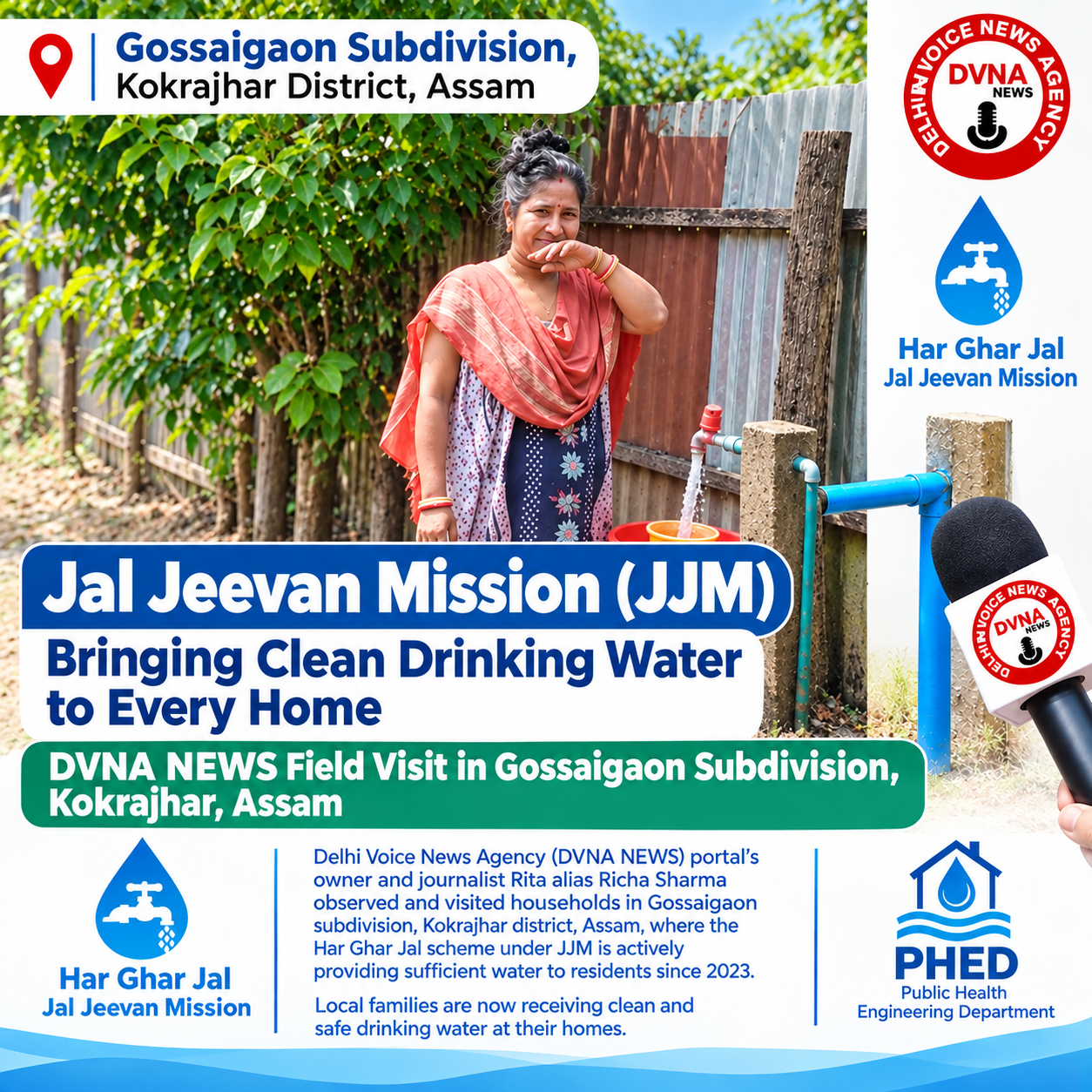
As India continues to expand rural access to piped drinking water under the Jal Jeevan Mission (JJM) – Har Ghar Jal, Delhi Voice News Agency (DVNA NEWS) carried out a field visit to Assam's Kokrajhar district and Gossaigaon subdivision in September 2026.
The objective of the visit was to understand how rural drinking-water infrastructure is translating into household-level access and to document the experiences of local residents.
The field visit was led by DVNA NEWS portal owner and journalist Rita alias Richa Sharma, who interacted with local residents and observed household-level water availability in Bhalukjohra village.
Focus on Household-Level Water Access
During the visit to Bhalukjohra, the DVNA NEWS team spoke with local households about their access to drinking water and the functioning of the local water-supply system.
According to the field observations and interviews conducted by DVNA NEWS, residents who were interacted with during the visit reported access to a sufficient supply of water for their household requirements.
The interaction provided a local perspective on the availability of drinking-water infrastructure and how rural families experience the system in their day-to-day lives.
What Is Jal Jeevan Mission?
The Government of Assam's Public Health Engineering Department (PHED) states that Jal Jeevan Mission aims to provide a Functional Household Tap Connection (FHTC) to every rural household.
The programme's service-level benchmark includes a provision of 55 litres per capita per day (LPCD), along with water-supply infrastructure, source sustainability, water-quality interventions and grey-water management.
Jal Jeevan Mission was launched nationally in August 2019. Assam has been implementing the programme through its rural drinking-water infrastructure system, with the Public Health Engineering Department (PHED) playing a key role.
Assam's Rural Water-Supply Progress
According to a December 2025 update from the Press Information Bureau (PIB), Assam had 58,98,638 rural households with functional household tap connections, representing 81.65% of the state's rural households at that time.
These figures represent statewide coverage and should not be interpreted as the coverage rate of any individual village. Village-level functionality and regularity of water supply require separate assessment.
Gossaigaon and Kokrajhar
Gossaigaon is one of the administrative subdivisions of Kokrajhar district. The official Kokrajhar district profile lists Kokrajhar Sadar, Gossaigaon and Parbatjhora among the district's subdivisions.
Assam PHED also maintains a dedicated Gossaigaon PHE Division, while the national Jal Jeevan Mission's water-quality monitoring system lists a Gossaigaon Sub-Divisional Level Laboratory.
From Infrastructure to Actual Service Delivery
A key question for any rural drinking-water programme is not simply whether a pipeline or tap has been installed, but whether households are actually receiving water as intended.
This distinction has become increasingly important as Jal Jeevan Mission places greater emphasis on reliable, safe and sustainable drinking-water services alongside infrastructure development.
In March 2026, the Union Cabinet approved Jal Jeevan Mission 2.0, with an increased focus on reliable and sustainable drinking-water service delivery.
What Residents Told DVNA NEWS
During conversations with residents, the DVNA NEWS team focused on everyday access to water, including whether sufficient water was available for household needs and how residents experienced the local supply system.
Based on the interviews and observations recorded during the visit, households interacted with by DVNA NEWS reported that water was available in sufficient quantity for their domestic requirements.
For rural families, dependable household water access can have practical implications beyond drinking water itself. When water is available closer to home, families may spend less time travelling to distant sources and collecting water for everyday domestic use.
Why Ground Reporting Matters
Government data provides an important picture of infrastructure, coverage and programme implementation. Ground reporting adds another layer by documenting how people experience that infrastructure in their daily lives.
The Bhalukjohra visit therefore sought to connect the official objectives of Jal Jeevan Mission with the experiences of rural residents.
For DVNA NEWS, the field exercise was an attempt to document not only the existence of drinking-water infrastructure but also the reported availability of water at the household level.
A Local Snapshot of an Ongoing National Programme
The situation observed in Bhalukjohra forms part of a much larger effort to expand rural drinking-water access across Assam and India.
While statewide government figures demonstrate substantial expansion of functional household tap connections in Assam, the actual performance of individual schemes and villages can vary and requires continued monitoring of regularity, adequacy, water quality and functionality.
The September 2026 field visit by DVNA NEWS provides a local account from Bhalukjohra, where residents interviewed by the news agency reported adequate household water availability.
The report highlights the importance of combining official programme data with direct conversations with beneficiaries to understand how rural drinking-water initiatives are functioning on the ground.
Delhi Voice News Agency
Field Report — Kokrajhar, Assam
September 2026