CJP’s ‘Lehra Do Tiranga’ Protest at Connaught Place: Questions Over Police Action, Public Access and Traffic Management
Rita Devee (Richa) Oct 22, 2026
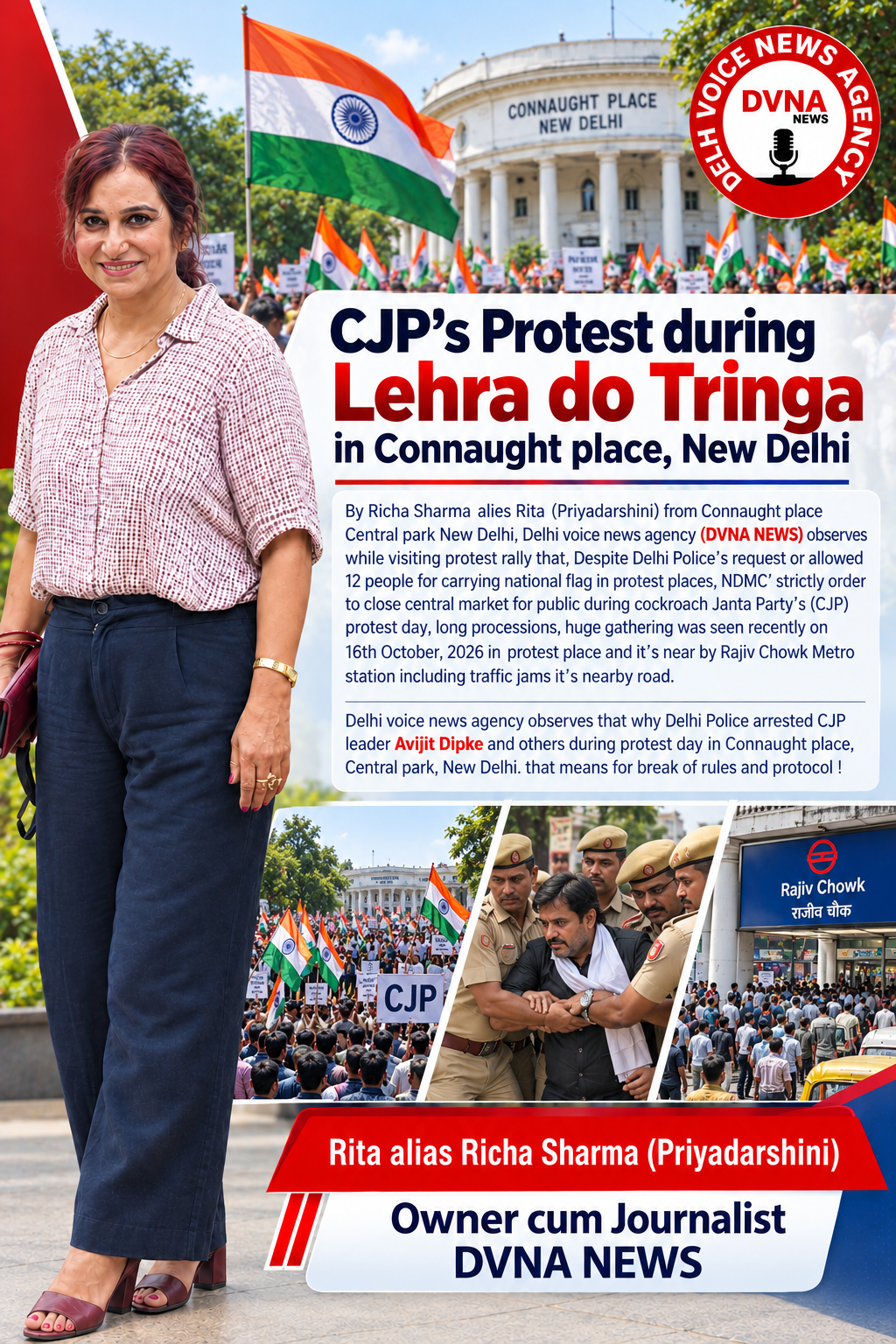
The CJP “Lehra Do Tiranga” protest at Connaught Place, Delhi, on 16 October 2026, raises questions about public access, traffic congestion, protest restrictions and the reported arrests of Avijit Dipke and other participants.
NEW DELHI: Connaught Place, one of the capital’s most prominent commercial and public destinations, reportedly witnessed a large gathering during the Cockroach Janta Party (CJP)’s “Lehra Do Tiranga” protest on 16 October 2026. The gathering around Central Park and the nearby Rajiv Chowk Metro station raised questions about crowd management, public accessibility, traffic congestion and the police action reportedly taken against CJP leader Avijit Dipke and other participants.
Richa Sharma, alias Rita (Priyadarshini), reporting for Delhi Voice News Agency (DVNA News), observed the protest area and noted the reported presence of a large gathering, processions and traffic congestion on nearby roads. The circumstances surrounding restrictions on the use of Central Park and the reported police action require further clarification from the concerned authorities.
The “Lehra Do Tiranga” campaign, as described in connection with the CJP protest, placed the national flag at the centre of the gathering. Central Park, situated in the heart of Connaught Place, is an important public space surrounded by commercial establishments, pedestrian routes and transport facilities.
According to the observations provided to DVNA News, the protest attracted a substantial gathering, with processions and activity extending into the surrounding area. The proximity of the gathering to Rajiv Chowk Metro station made crowd management particularly important, given the large number of commuters and visitors who use the area.
Whenever a political protest takes place in a busy commercial district, authorities face the challenge of balancing the right to peaceful assembly with public safety, pedestrian movement and the uninterrupted functioning of essential transport services.
One of the key issues raised by the reported observations concerns restrictions on public access to Central Park and the surrounding commercial area.
The account states that the Delhi Police had requested or permitted only 12 people to carry national flags at the protest location, while the New Delhi Municipal Council (NDMC) reportedly issued strict directions to close the Central Park market area to the public during the protest.
The precise terms of any police permission, the scope of the reported 12-person restriction and the nature of the NDMC directions need to be verified through official documents or statements.
If restrictions were imposed, important questions arise: What security or administrative considerations led to these decisions? Were the restrictions communicated clearly to the organisers and the public? Were alternative arrangements made for commuters, shoppers, local businesses and visitors?
These questions deserve transparent answers. Public spaces in busy urban areas require careful management, particularly when demonstrations coincide with normal commercial and transport activity.
The reported gathering and processions also drew attention to traffic conditions around Connaught Place and Rajiv Chowk Metro station.
Large demonstrations can affect road movement, pedestrian access and the daily routines of residents, office workers, shoppers and commuters. In an area as busy as Connaught Place, even temporary restrictions can create inconvenience if crowd-control measures and traffic diversions are not communicated effectively.
The observations provided to DVNA News describe traffic congestion on nearby roads during the reported protest. However, the precise extent and duration of the congestion, the number of participants and the specific traffic arrangements would need confirmation from the traffic police.
The incident highlights the importance of advance planning, clearly marked pedestrian routes, appropriate traffic diversions and timely public announcements during demonstrations in high-footfall locations.
A central question arising from the reported events concerns the police action against CJP leader Avijit Dipke and other individuals associated with the protest.
Why were they reportedly arrested? What specific grounds did the police cite? Was the action connected to alleged violations of protest permissions, restrictions on gathering, traffic-related concerns or another legal issue?
At the time of writing, the precise grounds for the reported arrests have not been independently established in the information available for this article. It would therefore be premature to conclude that the arrests were made specifically for breaking rules or violating protocol.
The relevant police statement, arrest records and any applicable permission conditions would help establish the facts. The CJP leadership should also have an opportunity to explain its position and describe its understanding of the restrictions imposed on the demonstration.
A transparent account of both the police position and the party’s response is essential for responsible public-interest journalism.
The reported events raise a broader question about how public authorities regulate demonstrations in prominent public spaces.
Peaceful assembly and expression are constitutionally protected in India, subject to lawful and reasonable restrictions. Organisers must comply with applicable legal requirements, while authorities must exercise their powers according to law and provide appropriate reasons for enforcement action.
The use of national flags during a demonstration does not, by itself, establish whether a gathering complies with all applicable rules. Equally, the existence of a restriction does not automatically establish that every participant has violated it.
The facts surrounding the permissions, the conduct of the participants and the reasons for the reported police action must be assessed before reaching conclusions about responsibility.
## DVNA News: Seeking Answers and Accountability
Delhi Voice News Agency considers the reported developments at Connaught Place an important subject for public discussion. The questions surrounding access to Central Park, the reported restrictions on carrying national flags, traffic congestion and the police action against Avijit Dipke and other participants warrant clear answers from the concerned authorities.
DVNA News invites the Delhi Police, NDMC and CJP representatives to provide their respective accounts, relevant documents and clarifications so that the incident can be reported comprehensively and fairly.
The objective is not to prejudge the actions of any individual or institution, but to establish what happened, why particular decisions were taken and whether the applicable procedures were followed.
## Conclusion: The Need for Clarity and Fair Reporting
The reported “Lehra Do Tiranga” protest on 16 October 2026 at Connaught Place has brought several important issues into focus: public access, crowd management, traffic planning, protest permissions and the grounds for police action.
The most important question remains: *What were the specific legal and administrative reasons behind the reported restrictions and arrests during the CJP protest?*
A complete answer requires verified information from the Delhi Police, NDMC and the protest organisers. Until those details are established, the incident should be examined through evidence, official explanations and the accounts of those present.
Reported by Richa Sharma alias Rita (Priyadarshini)
Delhi Voice News Agency (DVNA News)
Connaught Place, Central Park, New Delhi
Editorial note: This article is based on the observations and information supplied for drafting. The reported restrictions, crowd size, traffic impact and arrests should be independently verified before publication. Any official response or correction should be incorporated to ensure accuracy and fairness.
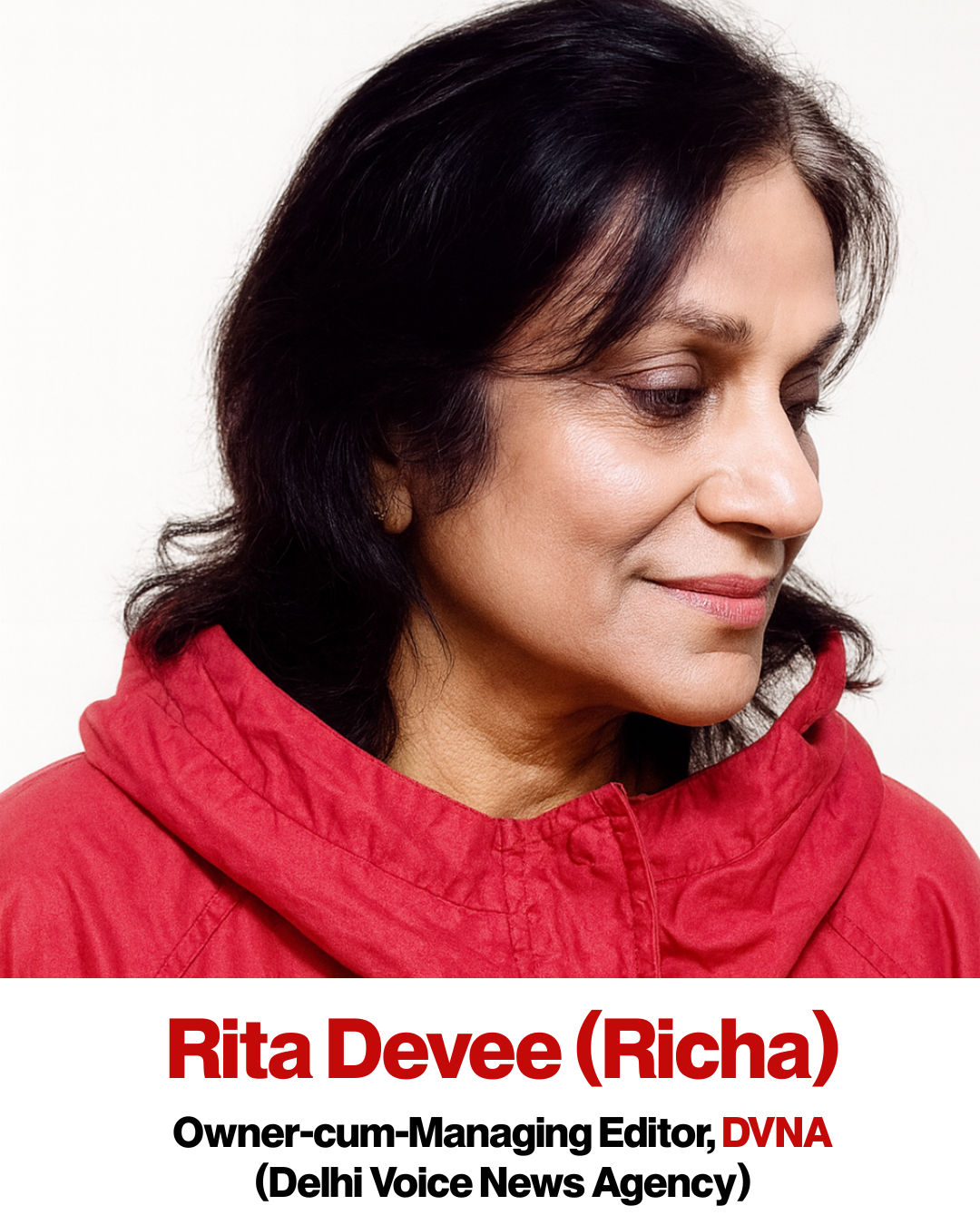
Who Is Working From Own Residance In South Delhi, Opprating From Bhagwan Sahai Tower, Noida Sector 15, 201301 India & Running With her 20 Years Experience In News Reporting In National News doordarshan (DD News) & NewsPapers Where She Used to Write Her Name as Priyadarshini, Rita and Richa Sharma. With Her Double Master Degree In journalism And Mass communication (JMC) and literature from Guwahati University and Madurai Kamaraj University Under UGC. & also Pursued Journalism Training In Delhi Under India Can Manage By Ex NDTV Team.
Contact us: delhivoicericha@gmail.com
Call/Whatsapp: +91 9625942970
Call/Whatsapp: +91 8453708864
Rita Devee (Richa) Oct 22, 2026
Rita Devee (Richa) Sep 26, 2026
Rita Devee (Richa) Sep 23, 2026
Rita Devee (Richa) Sep 22, 2026
Rita Devee (Richa) Sep 21, 2026
Rita Devee (Richa) Sep 19, 2026
Rita Devee (Richa) Sep 16, 2026
Rita Devee (Richa) Sep 14, 2026
Rita Devee (Richa) Sep 11, 2026
Rita Devee (Richa) Sep 09, 2026



Who Is Working From Own Residance In South Delhi, Opprating From Bhagwan Sahai Tower, Noida Sector 15, 201301 India & Running With her 20 Years Experience In News Reporting In National News doordarshan (DD News) & NewsPapers Where She Used to Write Her Name as Priyadarshini, Rita and Richa Sharma. With Her Double Master Degree In journalism And Mass communication (JMC) and literature from Guwahati University and Madurai Kamaraj University Under UGC. & also Pursued Journalism Training In Delhi Under India Can Manage By Ex NDTV Team.
Contact us: delhivoicericha@gmail.com
Call/Whatsapp: +91 9625942970
Call/Whatsapp: +91 8453708864
Sep 26, 2026
Sep 23, 2026